Monday, 21 January 2019

Music Video Introduction

The in-depth study of two music videos

  • The music videos from List A could be regarded as 'mainstream' as they come from commercial artists who have been signed by 'major' record labels. The music videos all feature their respective artist(s) and are a mixture of performance and narrative, and raise the number of similar representational issues surrounding 'street life'.
  • The music videos in List B from alternative or less commercial artists. These music videos do not feature their respective artist(s) at all, instead, with each music video celebrating the power of narrative and signification and a postmodern emphasis on intertextuality. The videos in List B each use very different representations to each other, but each contrasts clearly with the representations featured in the music videos in List A.
What does record label do?
  • A record label is responsible for production, manufacture, distribution, marketing, and promotion of music.
  • They enforce copyright laws
  • They conduct scouting and development of artists.
  • They maintain contracts with recording artists and their managers.
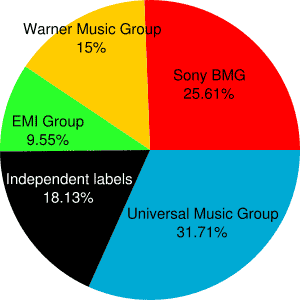
The 4 major record labels are:
  • Warner Bros
  • Universal
  • EMI
  • Sony
They are the parent companies of many small labels, including:
  • SyCo Music
  • Island Records
  • Atlantic
  • Epic
  • Aftermath
  • Cash money Billionaire
  • and many more...

Media Ownership
  • Universal is the largest media owner of the music industry
  • Independent labels are smaller and often focused on more alternative genres.
  • An example:
    • Gingerbread Man Records, Ed Sheeran's record label. Owned by a bigger brand Atlantis


What do A&R people do?
  • A&R stands for Artists and Repertoire. This is the division of a record label that is responsible for talent scouting and the artistic and commercial development of the recording artist. It also acts as a liaison between the artist and the record label.
  • The role of A&R has three main responsibilities:
    • Finding talent
    • Overseeing the recording process
    •  Assisting with marketing and promotion
  • As you can imagine, going to clubs, scouting new talent, chatting regularly with recording studios, superstar producers, and major stars, makes this one of the most sought after jobs in the recording industry.

The song production process:
  • A&R scouts find an artist
  • A contract is signed
  • An album producer is at the centre of the process
  • Marketing may begin well in advance
  • Team of songwriters produce songs
  • Backing vocal artists are sourced and recorded
  • Label heads oversee production and manage budgets
  • Session musicians are employed, samples recorded
  • The star records their vocals
  • Music videos are produced
  • The album is streamed or tracks given away
  • The album is marketed and distributed globally

Who makes money?
  • The contract will dictate the percentage of ownership of any profit made from a single song or album sale.
  • Typically a superstar royalty rate is 20%
  • Apple will take 30% of an album sale through Apple music
  • Songwriters earn royalties when a song is played on the radio/adverts etc
  • Artists earn money from touring ticket sales and album sales

Shelter Essay

Shelter is a charity which helps people who are struggling with bad housing or homelessness. The 3 models (2 women and a man) are fearful of losing their homes. All the models have a close-up shot of their faces, which are all in misery and despair. They are all giving direct addresses to the audience which portrays how desperately they need the community's help to maintain their homes.  The words that are written on the advert explains the different scenarios individuals can go into for them to lose their accommodations. For example, a person lost their job but that doesn't mean they can lose their homes with the help of Shelter. Additionally, debt and being a tenant are other examples of people using the charity. All 3 of the adverts carry out a single headline which shares the viewer the desperation the person is feeling. By individuals reaching out to them, the charity solves their problem in any scenario and have left thousands of individuals or families with smiles on their faces knowing that they won't be homeless. The charity is a direct response to Cameron's coalition government (CSR) cutting its funding for social housing by 60% which has a catastrophic effect on people who have previously depended on affordable and secure social housing which is provided by the council and housing associations and has a fixed rent. Shelter said that the CSR is "prepared to deny responsibility for ensuring that people can access decent, secure, affordable housing. A recent study has found out that 50% of people do not seek external advice when they encounter housing difficulties, therefore, Shelter tries to prevent that from happening and for the charity to resonate with people experiencing these problems and tap into their concerns, which is them seeking advice on the Shelter website. The Advertising Standards Authority (ASA) is the regulatory body for adverts in the UK. It is in their absolute power for them to pull any adverts that have been complained by a member of the public or a company. All adverts have set strict rules they must follow such as not containing comparisons to other charities, not addressing any fundraising message specifically at children, respecting the dignity of those no whose behalf an appeal is being made and the list goes on. The Shelter adverts achieve this by the models being respected of them volunteering to share their disappointing stories to the public however they also illustrate how Shelter is there to help those that are in threat of becoming homeless.
Monday, 14 January 2019

Shelter (Charity Advert Analysis)

Charity adverts and context
  • The social / cultural / political contexts we will focus on are:
  • Shelter as a charity
  • The Advertising Standards Authority (ASA) and its regulatory framework
  • The government’s comprehensive spending review of 2010, in which spending on social housing was cut by 60%, with a catastrophic impact on homelessness.
  • Social housing - provided by council or housing associations.
    • Affordable, secure, rents are set/fixed
About the campaign and the charity
  • Shelter is a charity which helps people who are struggling with bad housing or homelessness.
Advertising Standards Authority (ASA)
  • The ASA are the regulatory body for advertising in the UK.
  • Set strict rules on advertising
  • They have the power to "pull" any adverts that have been complained about a member of a public or a company.
  • They will investigate complaints and agree/disagree.
  • Advertisers have to adhere to ASA guidelines
ASA on charity adverts. They must:

  • handle with care and discretion matters likely to arouse strong emotions in the audience;
  • not suggest that anyone will lack proper feeling or fail in any responsibility through not supporting a charity;
  • respect the dignity of those on whose behalf an appeal is being made;
  • not address any fundraising message specifically to children;
  • not contain comparisons with other charities;
  • avoid presenting an exaggerated impression of the scale or nature of the social problem to which the work of the charity is addressed, eg. by illustrating the message with non-typical extreme examples;
  • not misrepresent or mislead in any way about the charity, its field of activity or the use to which donations will be put.

Government Comprehensive Spending Review: Contextual Information
  • Communities and local government
  • Annual budget: £33.6bn
  • Funding for social housing can be cut by more than 60%, with the new tenants having to pay higher rents.
  • But the government hopes these changes will free up funds to build 150,000 new affordable homes over the next for years.
What did Shelter say about these cuts?
  • ‘Shelter is greatly concerned that housing, one of the most basic needs for every single person in this country, is facing some of the biggest cuts. A succession of governments has failed to address our housing crisis and this CSR indicates that the coalition is also prepared to deny responsibility for ensuring that people can access decent, secure, affordable housing.
  • The combined worry of cuts to housing benefit and the slashing of the affordable house building subsidy will be devastating for the housing aspirations of thousands of young people consigned to increasing costs and bringing up their future families in an insecure private rented sector.
The Campaign
  • The Campaign was a direct response to the CSR. This is Shelter: A recent study found that 50% of people do not seek external advice when they encounter housing difficulties.
  • The main focus of the activity is a series of poster ads.
  • Each one depicts an ordinary person in distress because they are facing a serious crisis, such as sudden job loss or mounting debt. They carry a single headline which shares with the viewer the desperation the person is feeling.
  • The aim is for the combined impact of the headline and image to resonate with people experiencing these problems and tap into their concerns, driving them to seek advice on Shelter’s website.
Shelter context
  • 2010 - government cut its funding for social housing at 60% = catastrophic effect on people who'd previously depended on affordable/ social housing.
  • CSR - Cameron's coalition government
  • Shelter - focus is on those at risk of homelessness. Advice/prevention
  • ASA - regulates advertising framework for all ads; might be apt for charity ads
The Question

How is media language used in the shelter advert? Refer to the social, political and cultural contexts in your response.
(500 words)

Shelter is a charity which helps people who are struggling with bad housing or homelessness. The 3 models (2 women and a man) are fearful of losing their homes. All the models have a close up shot of their faces, which are all in misery and despair. They are all giving direct addresses to the audience which portrays how desperately they need the community's help to maintain their homes.  The words that are written on the advert explains the different scenarios individuals can go into for them to lose their accommodations. For example, a person lost their job but that doesn't mean they can lose their homes with the help of Shelter. Additionally, debt and being a tenant are other examples of people using the charity. All 3 of the adverts carry out a single headline which shares the viewer the desperation the person is feeling. By individuals reaching out to them, the charity solves their problem in any scenario and have left thousands of individuals or families with smiles on their faces knowing that they won't be homeless. The charity is a direct response to Cameron's coalition government (CSR) cutting its funding for social housing by 60% which has a catastrophic effect on people who have previously depended on affordable and secure social housing which is provided by the council and housing associations and has a fixed rent. Shelter said that the CSR is "prepared to deny responsibility for ensuring that people can access decent, secure, affordable housing. A recent study has found out that 50% of people do not seek external advice when they encounter housing difficulties, therefore, Shelter tries to prevent that from happening and for the charity to resonate with people experiencing these problems and tap into their concerns, which is them seeking advice on the Shelter website. The Advertising Standards Authority (ASA) is the regulatory body for adverts in the UK. It is in their absolute power for them to pull any adverts that have been complained by a member of the public or a company. All adverts have set strict rules they must follow such as not containing comparisons to other charities, not addressing any fundraising message specifically at children, respecting the dignity of those no whose behalf an appeal is being made and the list goes on. The Shelter adverts achieve this by the models being respected of them volunteering to share their disappointing stories to the public however they also illustrate how Shelter is there to help those that are in threat of becoming homeless.

Media Exam Dates

Paper 1 Media Messages: 5th June (am)

  • News = big topic
  • 2 out of 3: Magazines, Adverts, Music videos
Paper 2 Evolving Media 13th June (pm)
  • TV Drama  = big topic
  • 2 out of 3: Film, Gaming, Radio

Lucozade Advert Essay

There is a mid-close-up shot of Gareth Bale portraying his jersey as well as his serious face expression to the audience, therefore, he is giving the direct address. Lucozade have deliberately used Bale to sponsor in one of their adverts because he is top end athlete (footballer who plays for Real Madrid which the football club acquired him for a huge amount of money) who has a clean reputation (meaning that he has never been frowned upon by his team nor the media) so that the product can't be looked down on by the consumers. He is nicely groomed with his hair being gelled and that he is cleanly shaven. There is a line of dirt on his chin which further portrays that he plays a sport. Since Bale is expensive for the Real Madrid Football Club (which is one of the best football clubs in the world), this makes him the perfect sponsor for Lucozade and to use him as the face of the brand. Lucozade has written the slogan "In a different league" is a pun for two different things: the fact that Bale is literally in a different league, from the transition from the Barclays Premier League to the Spanish League "La Liga" and the belief that Lucozade is that the superior product and that it is on top of the competition. On the top right corner of the printed advert, there is Bale's football card which is his player profile. This shows authenticity to the consumer to further convince them to buy the product. The colours that Lucozade has used for the advert: blue and yellow reinforces branding as those are the colours used for their brand. As yellow is a bright colour and their secondary colour, the consumer subconsciously looks for the colour as it stands out for them. The features of the advert that has yellow are the slogan, their brand name at the bottom left corner which is followed by a bold "YES" which is covered in white and the product at the bottom right corner. There is a close-up shot of the product which captures the full length of the product. This gives the product credibility because it stands out and it is a persuasive ethos to the consumer, as it convinces the consumer to buy the product and they will be empowered to be "in a different league" above everybody else.
Lucozade Advert Analysis

Image result for in a different league advert


  • Gareth Bale - footballer
    • Real Madrid (ex Tottenham Hotspurs)
    • Leader, "clean" reputation
    • grooming/styling: hair, clean shaven
    • links to Lucozade as a brand
    • Expensive acquisition for Real Madrid
  • Mid-close up shot (MCU) - portrays facial expression and the top of the football kit
  • Slogan: "In a different league"
    • Double meaning: Bale: Transfer from premiership to la liga
    • Lucozade: superior product
  • Top right - player profile: authenticity (Football cards)
  • Colour scheme: reinforces branding
    • Blue and Yellow
  • Close up (CU) in the bottom right of the product
    • Persuasive-ethos/credibility

There is a mid close up shot of Gareth Bale portraying his jersey as well as his serious face expression to the audience therefore he is giving direct address. Lucozade have deliberately used Bale to sponsor in one of their adverts because he is top end athlete (footballer who plays for Real Madrid which the football club acquired him for a huge amount of money) who has a clean reputation (meaning that he has never been frowned upon by his team nor the media) so that the product can't be looked down on by the consumers. He is nicely groomed with his hair being gelled and that he is clean shaven. There is a line of dirt on his chin which further portrays that he plays sport. Since Bale is an expensive for the Real Madrid Football Club (which is one of the best football clubs in the world), this makes him the perfect sponsor for Lucozade and to use him as the face of the brand. Lucozade has written the slogan "In a different league" is a pun for two different things: the fact that Bale is literally in a different league, from the transition from the Barclays Premier League to the Spanish League "La Liga" and the belief that Lucozade is that the superior product and that it is on top of the competition. On the top right corner of the printed advert, there is Bale's football card which is his player profile. This shows authenticity to the consumer to further convince them to buy the product. The colours that Lucozade has used for the advert: blue and yellow reinforces branding as those are the colours used for their brand. As yellow is a bright colour and their secondary colour, the consumer subconsciously look for the colour as it stands out for them. The features of the advert that has yellow are the slogan, their brand name at the bottom left corner which is followed by a bold "YES" which is covered in white and the product at the bottom right corner. There is a close up shot of the product which captures the full length of the product. This gives the product credibility because it stands out and it is a persuasive ethos to the consumer, as it convinces the consumer to buy the product and they will empowered to be "in a different league" above everybody else.

Sunday, 13 January 2019

Old Spice Advert Essay

Isaiah Mustafa is a sponsor for the Old Spice brand which has a range of male grooming products encompassing deodorants and antiperspirants, shampoos, body washes and soaps. On the printed advert, it shows a mid-close up shot of Mustafa merged with the beach with a volcano on top of his head and with blue skies on top of him. This is to resemble the Bahamas in the Caribbean so that it can initially catch the audience's attention. On the advert, it is written "Old Spice Bahamas scent comes from an antiperspirant mine in the Bahamas. This fact has not been fact-checked". This quote makes this a self-referential advert meaning that it is known that it is silly therefore it is a parody to other adverts as it refers to other men's toiletry advert. The advert resembles the landmarks of the Bahamas and referring itself to other adverts gains the advert intertextuality, making this a breaking genre as this breaks boundaries between genres. There are some postmodern theories that can be integrated into the advert such as McLuhan's Global Village Theory, which is the compromisation of time and space and mix and match between two different things (which is the Mustafa and the Bahamas). As this is a man grooming brand, there is always this stereotypical idea of it being used as a way for women to be attracted to the consumer, and this is with no exception with Old Spice, however, it does make fun of the idea. In the 30 second long advert, there are numerous of times when Mustafa said to the women look at their partners and then to look back at him and he is always doing another action where he could be dressed differently or in a different location for example. This could possibly hypnotise the consumer (which are men) into thinking that when they use the product, they could do those actions themselves or do even more and surpass him, as the advert gives them empowerment and authority to do whatever they want to do. Butler's gender performativity is used on this advert and it is that genders (particularly men) are created in how we perform our gender roles and that it is created through performance. This reflects on the performance that is created through Mustafa; how men are stereotypically fit so that they can be shirtless and show off their six-pack abs and them having the capabilities to do anything and this is an example of hegemonic masculinity.

Tuesday, 18 December 2018

Advertising and Marketing

Old Spice - Male grooming products
Isaiah Mustafa Campaign

  • Self-referential advert- knowing that it's silly, referencing other men's toiletry advert
  • Relatively cheap to the mass market
  • Parody/mickey-taking of other adverts.
  • Intertextual
  • Post-modern:
    • Mix and match - time and space
    • Breaking genre
    • Reality/Fantasy
  • "Become yourself"/"The mark of a man"
Bathes: Denotation/Connotation (Semiotics theory)
  • Physical form - what we see or hear (Red rose)
  • Meaning - which relates to society's ideology/cultural context (Romance)
  • Myth - when symbols/signs come to represent whole sets of ideas in a society
Old Spice and gender representation
  • Butler's gender performativity: Gender is created in how we perform our gender roles - there is no essential gender identity behind these roles, it is created in the performance. Performativity is not a singular act but a repetition and a ritual that becomes naturalised within the body.
  • Any feminism concerned only with masculinity and femininity excludes other forms of gender and sexuality. This creates 'gender trouble' for those that do not fix the heterosexual norms. 

Monday, 26 November 2018

Analysing the Big Issue

Go to Moodle and click on the folder titled: Big Issue education front cover
Class Action/Intertextuality

  • When one media product ("text") is only understood in relation to another media product ("text")
Intertextuality on "Class Action" cover:
  • Harry Potter: Harry, Ron, Hermione
  • Handmaid's Tale: Offred
  • Benedict Cumberbatch: Hollywood actor
  • Ozzy Osbourne: Rock Star
  • Miss Jean Brodie: Schoolmistress

Tuesday, 20 November 2018

The Big Issue - Theories around representation

Barthes and semiotics

  • Denotation
  • Connotation
  • Anchorage
  • What this tells us about who/what is represented
Hall and ideology
  • Hall believes that the media reflects dominant ideologies, and the majority of mass media artefacts reinforce generally agreed messages around gender, culture / ethnicity, consumerism, the family, social class and so on. Some artefacts are polysemic (more than two meanings), but most have a limited number of readings, favouring a preferred audience reading.
  • Some audiences take a negotiated position.
  • A small minority might make an oppositional reading.
Prince William Front Cover


  • Dominant: "Prince Charming", Archetype, Privilege - royal
  • Oppositional: Republican - Anti-monarchy, What does the prince know about homelessness
Bake Off Front Cover


  • Intertextuality - to Trump
  • Dominant: Britishness - a "mythical" version, safe, homely
  • Oppositional: all white, not diverse
Gauntlett - a post modern approach
  • Identity is complicated
  • Building your own identity. No fixed representations
  • Post-modern/ mix and match approach
  • Might link to intertextuality: explicit reference to other media products, where the meaning is only apparent in reference to this other text (inter-text).
Van zoonen and Hooks: feminist theories
  • Van Zoonen: Women’s bodies as objects
  • Men’s bodies as spectacle
  • Gender performativity: what we do rather than what we are
  • Gender is contextual
  • Bell Hooks: intersectionality. (Black female) audience to develop an “oppositional gaze.” This refuses to identify with characters
Madonna Front Cover


  • Portfolio - objectified, sexual
  • Contrasts with Big Issue where "uncovered" does not link to her sexuality and she is visibly older.
Gilroy and post-colonialism
  • Diaspora* has constructed a transatlantic culture
  • “Other”ness: most non-white representations emphasise otherness (from white, middle-class, male dominant representations), rather than any inherent characteristics
  • (* originates from the movement of Jewish people from middle east Europe, later USA. Refers now to movement of immigrants to the west.)

Tuesday, 6 November 2018

The Big Issue Notes

Notes

  • In 1991, John Bird and Gordon Roddick (founder of the Body Shop cruelty-free toiletries) founded the Big Issue.
  • Made "A Publishing Revolution".
  • Social Enterprise - a business that makes profit, but has social benefits
  • Sold over 200 million copies in the UK since 1991.
  • Expended their business portfolio and expanded their brand to the big issue shop which sells products with a social agenda
  • The big issue invest is also another brand extension which invests in other social enterprise
  • They buy products and doubles the amount
"Ethical Capitalism" - John Bird - making profit, but morally right

"A hand up, not a hand out" - John Bird

"Social exclusion" - refers to those outside of society. Mentally ill, homeless, offenders, addicts

UGC - User Generated Content


The Big Issue

Monday, 29 October 2018

History of Magazines and Key Terms

Early Magazines

  • Magazines appeared in the UK in the late 1700s, although leaflets and posters had been printed by woodblock, then using printing machines, for many hundreds of years.
  • Early magazines include The Gentleman’s Magazine, in 1775 which included news, poetry, history, philosophy
The rise of the mass media
  • It was not until the late 19th century / early 20th century that the mass media started to take off, with wide access to magazines and newspapers, which were easy to buy, and affordable.
  • This pre-dates radio and television (and later, the internet) as a mass form of communication, which allowed the media to speak to huge numbers of audiences
  • Several of these early magazines still exist today, such as “Vanity Fair”
Independent Research
  • IPC
    • Taken over by Time Inc (T.I.) in 2014
    • TI was part of Warner group, one of the biggest conglomerates in the world
      • IPC decided this would save their magazines
      • Now TI is part of Meredith group, huge cross media interests.
    • Bauer Media
      • German company
      • Subsidiaries:
        • Women's weekly
        • Take a break
        • Modern Gardens
        • TV Choice (most sold UK magazine)
        • Kiss
        • 4Music
        • Kerrang
      • Global conglomerate company
    • Dennis
      • Independant
      • Niche products
      • Kung Fu
      • Minecraft
    Advertising in Magazines
    • Without advertising, no magazine could survive. If a magazine did not contain ads, then its COVER PRICE would be three or four times greater.
    • The INCOME for a magazine comes from both sales and advertising. On average, advertising accounts for 70% of magazine income.
    • A magazine with a small CIRCULATION is more dependant on advertising on one with a large one.

    Appeal to Advertisers
    • Magazines enable advertisers to target an audience vary precisely and  specifically
    • Magazine ads can offer more detailed information about a product than a TV commercial.